
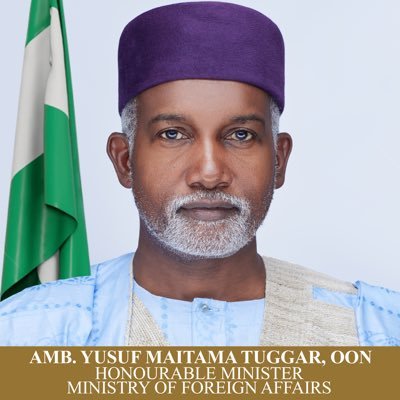
“Nigeria has never had expansionist tendencies, never been threatening towards our neighbours, and always chosen the path of peace and conciliation. This, in part, may have to do with the makeup of our polity and social fabric. Being such a huge country, we are used to the virtues of principled compromise.” – Yusuf Tuggar
It has been an interesting few years in our Sahelian neighbourhood, where, for a while now, Nigeria has been forced to pay closer attention to, for different reasons, ranging from the broken state of Libya, and the inflow of arms and fighters from there, to the deteriorating security situation made worse by the hold on territories by terrorists, interest by non-African state actors, and the shadowy involvement of a range of foreign non-state actors, climaxing in the overthrow of democratic governments in 3 countries (Mali, Burkina Faso and Niger), resulting in the diplomatic cold shoulder toward ECOWAS and the formation of a counter-force, in the the Alliance of Sahel States (AES).
That it has become a more dangerous neighbourhood, in which suspicion among neighbours has become unduly heightened, became evident over the last 9 days when a Nigerian C-130 Hercules aircraft had to make a precautionary landing in accordance with established safety procedures and international aviation protocols in Bobo-Dioulasso, Burkina Faso. What ordinarily ought to have been a routine processing of a distressed aircraft under the humanitarian principle of distress, as long as the crew followed the required protocols, was played up by the AES states, including Burkina Faso, placing their air defences on high alert after the landing, labelling it an “unfriendly act.” The incident would be further weaponised for purposes of propaganda, and an extended period of detention of the Nigerian crew of 11 and the aircraft.
But as I had argued elsewhere, it would have been a surprise if the Burkinabè Authorities had not seized the opportunity offered by the emergency landing incident to spin more yards of propaganda materials or leverage it for possible diplomatic engagement. Following the military coup in September 2022, ECOWAS members suspended Burkina Faso and imposed sanctions to pressure the regime for the restoration of democratic institutions.
That led to a limited engagement between the country and members of ECOWAS, including Nigeria, with the approach to the country moving from one of routine cooperation to conditional engagement, prioritising regional stability and counter-terrorism. Though the sanctions were partially lifted in February 2024 for humanitarian reasons, with only political and targeted measures to pressure for civilian transitions retained, the relationship hardly saw any marked improvement.
Until the surprise visit to Ouagadougou by ECOWAS Chair and Sierra Leone’s President Julius Maada Bio, on September 17, 2025, there had been no high-level visits by ECOWAS leaders to Burkina Faso since the 2022 Coup. Although Bio visited in August 2024, he did so as the UN Security Council Chair, not as a representative of ECOWAS.
So, having been largely kept at arm’s length by Nigeria and ECOWAS since the coup, this was an opportunity for Colonel Traore government to put on a show for its feel-good effect. The Burkinabe authorities will hold on to just about anything to further their desired narrative, which is exactly what played out here.
Nigeria handled things with the nous and maturity required for this situation, especially coming on the back of the role played by Nigeria in foiling the coup in the Benin Republic, which had obviously rubbed the AES Military leaders the wrong way. But rather than rush into taking any rash decision that might have escalated tensions, especially in the face of a misinformation and disinformation campaign making wild claims, including one alleging that the aircraft was equipped with sophisticated geo-mapping systems and technology for transmitting real-time intelligence from AES airspace to French bases, Nigeria applied tact and diplomatic know-how required to handle such a delicate situation without it degenerating. As Minister Yusuf Tuggar said in Ouagadougou, Nigeria’s priority in its engagement across West Africa is dialogue and regional cohesion.
That was clearly demonstrated in this case. It must have taken some level of consultations and high-wire engagement behind the scenes before the agreement that saw to President Bola Tinubu sending the by the Nigerian delegation led by the Minister of Foreign Affairs, Ambassador Yusuf Tuggar, which included the Director-General of the National Intelligence Agency, Chief of Policy and Plans, Nigerian Air Force, Nigeria’s Permanent Representative to ECOWAS, and Chief of Protocol at the Ministry of Foreign Affairs.
It is instructive that the talks did not only focus on the issue of the Nigerian Air Force pilots and crew, but on advancing political, security, and economic cooperation, with particular emphasis on coordinated responses to regional security challenges and collective action through existing sub-regional frameworks.”
Minister Tuggar reports that he not only conveyed a message of solidarity from President Bola Tinubu to President Ibrahim Traoré, but the discussion dwelt on shared regional priorities and an exchange of views on cooperation in several sectors, allowing for a review of “pathways for strengthening Nigeria-Burkina-Faso relations and advancing regional integration. He was said to have acknowledged the long-standing ties between the two countries, emphasising the importance of closer collaboration, especially “in addressing shared security and development challenges across the Sahel and the wider West African region.” It was in the spirit of the constructive engagement that the matter of the detention of the Air Force Crew and the aircraft was resolved.
It was always going to take diplomatic engagement for the situation to be resolved, but diplomacy requires time and patience. Minister Tuggar and the Foreign Relations team applied tact and diplomatic know-how in this case, reaffirming the importance of dialogue, confidence-building, and the effectiveness of diplomacy in addressing sensitive issues. It is good to see that the engagement with the Burkinabè authorities achieved results.
The incident might have inadvertently opened the window for improvement in diplomatic relations between the two countries, with both sides agreeing to “sustain regular consultations and pursue practical measures to deepen bilateral cooperation and regional integration, reflecting a shared resolve to promote peace, unity, and stability in the sub-region.” Whatever happens, it always comes back to diplomacy, as we have seen in this case. Diplomacy usually finds a way to win. Eventually.
Simbo Olorunfemi is a specialist on Nigeria’s foreign policy, a communications consultant, and the managing editor of Africa Enterprise. Email: Editor@enterpriseafrica.ng